



In the 6th century BC Anatolia, the heartland of modern Turkey, was home to numerous flourishing kingdoms inhabited by indigenous peoples and by migrants pushed eastward from Greece, the Balkans and Europe by hostile invasions.
Migrants from Greece brought the elements of Doric culture to Aeolia and Ionia, two kingdoms in western Anatolia centered near modern-day Izmir.
While Athens was just a backwater provincial town, the peoples of the Aeolian city of Smyrna (Izmir) and the Ionian cities of Phocaea (Foça), Teos, Ephesus, Priene, and Miletus built the foundations of classical Hellenic civilization.
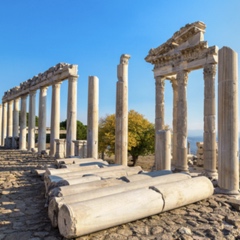
Thales of Miletus, the first great philosopher of the West, expounded his theories leaning against marble temple columns topped by graceful scrolled Ionic capitals.
Then came Cyrus of Persia, sweeping into Anatolia from the east in 547 BC and conquering every kingdom in his path.
The Persian invasion pushed the heart of classic Hellenic culture westward from Ionia back to Athens, which had successfully resisted Cyrus’s overextended armies. Athens took the lead in developing the culture that Ionia had fostered.
The Persians ruled Anatolia for two centuries, finally being pushed back to Iran in 334 BC by Alexander the Great.






 Best Travel Agencies
