


Throughout history, Asia Minor, which is now known as Anatolia and is a part of Turkey, has been home to many great civilizations. Among the ancient kingdoms of the Bronze Age were the Hittites, who also settled in the fertile lands of Asia Minor.
The Hittites were a civilization that existed in the Anatolia region during the Bronze Age, between 2600 BC and 1300 BC. Their capital, Hattusha, was located in Central Anatolia near Ankara. Numerous artifacts were discovered during excavation work. They were known for their advanced culture and religion, with a belief in over a thousand gods. Monumental carvings, rock reliefs, and metalwork depicting gods once spread across the Anatolian region, and some are still preserved.
History of Hittites
Except for a few references in the Bible, we knew little about the Hittites until explorer Charles Texier discovered the ruins of Hattusha in 1834. Excavations began in 1905 and revealed thousands of clay tablets written in cuneiform, giving the history and laws of the land. Art objects from daily life show that the Hittites had a marvelous artistic culture as well. The Hittites worshipped a pantheon of more than 1000 gods and goddesses, prime among them Teshub, the Storm God, and Hepatu, the Goddess of the Sun.
Here's the story of the Hittites, in short:
2600 to 1900 BC: In the Old Bronze Age, towns of considerable size were built in Anatolia by people we call the Hatti, or "Proto-Hittites."
1900 to 1600 BC: In the Middle Bronze Age, the Hittites themselves invaded Anatolia, taking over from the indigenous peoples.
1600 to 1500 BC: Early Hittite Kingdom, the Hittites founded Hattusha (modern Boğazkale) and made it their capital.
1500 to 1300 BC: Hittite Empire: The Hittites expanded, conquering Babylon and taking Syria from the pharaohs of Egypt. However, between 1300 and 1200 BC, a massive invasion of "Sea Peoples" from the Aegean weakened their rule.
Visiting Hittite Sites and Artifacts
Today, one can visit various historical Hittite sites that have been excavated throughout the Anatolia region. These sites range from open-air museums and exhibitions featuring preserved wall carvings to fully excavated settlement areas.
If you are particularly interested in the Hittite artifacts, most of the artifacts recovered from Hattusha (the capital of the Hittites) are now in the excellent Museum of Anatolian Civilizations in Ankara, though there is also a small museum in Boğazkale next to the Hattusha ruins.
Let's take a look at the prime places to explore Hittite history and culture in Turkey:
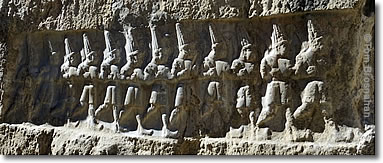
Hittite soldiers in procession at yazılıkaya.
Ankara
Ankara is the capital of Turkey and boasts some of the most extensive museums in the country. Near the ancient hilltop fortress in the center of the Turkish capital stands the Museum of Anatolian Civilizations, the richest collection of Hittite artifacts in the world, housed in a restored Ottoman caravanserai.
Boğazkale
The small yet impressive town of Boğazkale is 200 km (124 miles) east of Ankara and is next to the ruins of Hattusha and the rock-carved reliefs of Yazılıkaya. YalızKaya is a Hittite open-air temple and one of Turkey's most well-preserved Hittite sites.
Alacahöyük
Only 36 km (22 miles) north of Boğazkale, Alacahöyük is a smaller Hittite city with ruins and a museum, and the homeplace for most of the Hittite artifacts now exhibited in the Ankara Museum.
Çorum Museum
Located just outside of Boğazkale, in the Çorum province, is the Çorum Museum. While not as extensive as the Ankara Museum, the museum still houses some Hittite artifacts.
Karatepe-Aslantaş National Park
Karatepe-Aslantaş is 28 km (17 miles) north of Osmaniye, east of Adana, and north of Antakya. At the eastern end of Turkey's Mediterranean coast, this forested hilltop national park holds the ruins of a late Hittite city with monumental city gates and walls. Moreover, the open museum inside the national park exhibits a number of Hittite stone works.
Kültepe
Located near Kayseri, Kültepe, also known as Kaniş (Kanesh), is the ruins of an ancient Hittite city called Kaneš or Neša in historical records. Although only the foundations of this ancient city have survived, it is still fascinating to imagine what the settlement was like in its day.
Yesemek Open-Air Museum
Yesemek is an ancient Hittite quarry and workshop located near Gaziantep. It was used to prepare a number of statues that were intended to be spread across the empire. After the empire collapsed, the site was abandoned, and it now serves as an open-air museum.
Other Sites
Hittite artifacts have been found in many other places in Anatolia, especially at Malatya's Aslantepe and Carchemish (Karkamış) near Gaziantep. Moreover, you can find rock reliefs scattered throughout Anatolia, such as Eflatunpınar, İvriz, Darende, Manisa Relief, and Karabel Relief.
—by Tom Brosnahan, updated by Duru Nemutlu.
Read More
The Phrygians (1200 to 600 BC)
Hellenic Civilization (1200 to 600 BC)
Alexander the Great (334 BC)


 Best Travel Agencies
