



Hygiene has been an important part of Turkish culture for a long time, and it reflects on the daily habits of Turkish people. Turkish restrooms, which can be separated into contemporary Western-style toilets and conventional squat toilets, also exhibit this characteristic.
And since we all use the toilet (tuvalet) several times daily, it's important to know about them for your trip to Turkey.
How to Spot Toilets in Turkey?
Toilets are marked generally with "WC," "Tuvalet", and the words "Bay" (Mr, male) or "Bayan" (Ms, female) in Turkey. You can also see pictograms or gender-marker items such as a tobacco pipe for men and a fan for women. Read more in our Turkish Language Guide.
For those wondering, there are virtually no gender-neutral bathrooms in Turkey, yet. But they might become more prevalent in the future.
Surprisingly, Istanbul Airport has "Pet Relief Rooms," which is a bathroom for pet animals that passengers can utilize for their furry friends after a long flight.
In general, you can find restrooms in gas stations, malls, restaurants, and other public facilities (sometimes at or near mosques, as well). However, not every store or restaurant has a public restroom, and not always at public transportation stations. There are generally signs (labeled WC) that you can spot if nature calls when you’re in the middle of a bazaar or other place that lacks a large, centralized facility.
There are ample rest stops along Turkish highways with free public restrooms.
Using Toilets in Turkey
 While there are many public toilets operated by the local governance and can be used for free, there are also public toilets operated privately and usually charge a small fee for use. A few may differentiate between büyük abdest (bowel movement) and küçük abdest (urination) and charge more for the former than for the latter, but nowadays, it's mostly a flat fee for whatever you might need to do.
Keep in mind you need to pay the fee before going in the bathroom.
Types of Toilets in Turkey: Western vs. Squat Toilets
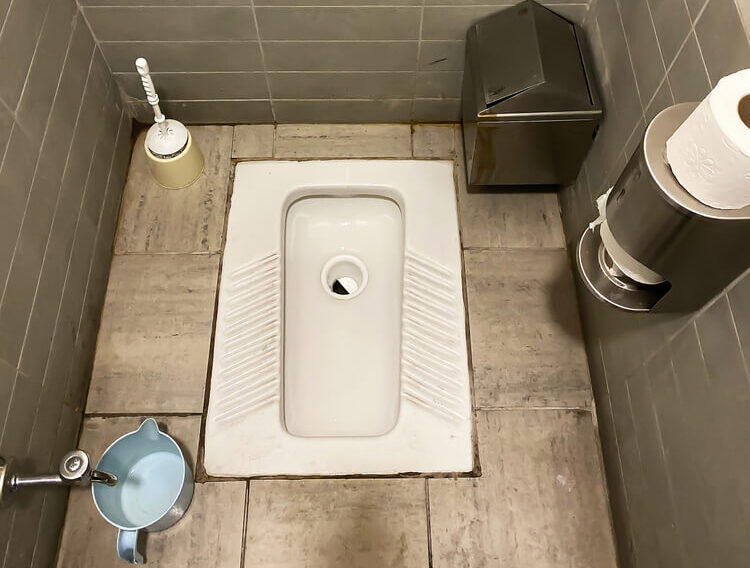
Most of the toilets you'll encounter in Turkey are of the standard Western raised-commode type, and the newer models have two-flush mechanisms that make a small flush for liquids and a large flush for solids in order to conserve water. However, you can also see alaturka tuvalet also known as a 'Turkish Toilet,' or a 'squat toilet’.
Using a toilet without a seat may seem scary to someone used to a raised commode, but it's actually quite hygienic once you get used to it because only your feet touch the toilet. It also puts you in what doctors might call an "anatomically correct position" for the swift and efficient completion of the business at hand. Just don't let all the stuff fall out of your pockets into the flat toilet while you're squatting!
Although you'll see more of these flat alaturka (traditional) toilets in public restrooms and in the less developed regions of the country, both styles of toilet are used by the local population, so even new buildings will have flat toilets installed along with the commodes.
So, if you see a squat toilet, chances are you can also spot a Western raised-type toilet in the same bathroom, possibly in a handicapped stall.
While it is up to you which toilet to use, both will be equipped with a bidet.
Turkish Toilet Hygiene
Both types of toilets have an accompanying device used for washing after your business. The newer toilet models will have a pre-installed bidet that's positioned perfectly to cleanse without effort. Try spinning the valve, generally located on the lower part of the wall of the toilet, and enjoy the life-changing stream of water. Some Westerners may even find they missing having a bidet after returning home.
In traditional squat toilets, a spigot and/or a water container for washing the left hand after use can be spotted. These provide water to the small white nozzle at the back of the bowl for washing the left hand after it has been used for cleaning oneself. The bare left hand was traditionally used for personal hygiene. While this is not the case today the spigot can still be spotted in traditional Turkish toilets.
Don't worry, as toilet stalls will (usually) also be furnished with toilet paper, so you don't have to adjust to local culture if you don't wish to. It is always a good idea to keep pocket tissue with you in case. However, keep in mind some older plumbing, built with only water in mind, is not able to deal with large amounts of toilet paper and will clog and overflow if much toilet paper is flushed into it. So, consider this a forewarning if you use Airbnb in an older, traditional Turkish house.
A waste bin is placed near the toilet, and users are asked to put used toilet paper into the bin instead. This is fine if the paper is used only for drying after cleansing (traditionally done in Turkey) but generally you should flush toilet paper which has been used. Just remember you may need to flush a few times as plumbing may only refill with a small amount of water, particularly compared to American toilets which consume large amounts of water.
How do Turkish Locals Use Toilets?
In April 2015, Turkey's supreme Islamic religious body, the government Diyanet, issued a fetva [religious legal determination] that using toilet paper for cleaning was permitted, but washing with water was still the preferred method as it provides further hygiene. However, nothing was said about the reason for using paper as a protective barrier.
In modern Turkey, almost all people will use a bidet to first wash and toilet paper to wipe for further hygiene. Hands are washed with soap afterwards.
Toilets in Turkey
Bathroom etiquette in Turkey is highly hygienic, combining traditional and modern methods. Using a bidet is the standard for toilet use in Turkey, and hands are washed thoroughly afterward.
Moreover, toilet paper is utilized in all bathrooms as a supplement to further promote hygiene and comfort. So, you don't have to worry about adapting to local culture if you don't wish to.
—by Tom Brosnahan, updated by Can Turan



 Best Travel Agencies
