


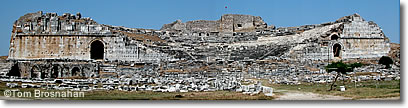
Miletus is known for its gigantic 25,000-seat Hellenistic theater, reconstructed by the Romans and perhaps the most impressive theater structure in Anatolia.
Located on the southern edge of the Meander River flood plain, 22 km (14 miles) south of Priene (map), Miletus was an important Ionian city for 1400 years, from about 700 BC to 700 AD.
It's the central of the three ancient sites (Priene, Miletus andDidyma) you can visit on a day trip from Selçuk (Ephesus) or Kuşadası. More...
The city has a solid place in history. Thales of Miletus (6th-5th century BC), one of the Seven Sages of Greece, has been called "the founder of science," with especially great contributions in the fields of geometry and astronomy. It was in Miletus that St Paul met with the elders of the church of Ephesus (the Ephesians) before his final journey to Rome. Isidore of Miletus was one of the two men who changed the course of architecture with the design of Hagia Sophia in Istanbul.
Though a settlement was known to be here in Hittite times, it was the Ionian Hippodamos who gave Miletus its street grid plan, a revolutionary feature of urban planning that was copied in nearby Priene, and later by all new Roman cities. Made rich by maritime commerce and its colonies, Miletus prospered through Byzantine and Seljuk times, but finally died when its harbor filled completely with alluvium from the Meander River.
Nowadays, with the Meander flood plain covered in cotton fields, it's difficult to imagine ships docking right in front of the theater where the parking lot and restaurant now stand, but so it was.
Today you drive across the flood plain from Priene on a straight road bridging irrigation canals and the much-dwindled Meander River (Büyük Menderes Nehri) to reach the ruins of Miletus. If you park in the parking lot, as a man will insist, you pay a few TL, and to enter the theater you pay a few more TL, and to use the toilet you pay yet more TL.
My suggestion for how to tour the theater: walk to the left (north) side of the theater, enter the huge portal (se the photo above), and climb the stairs inside. You'll see how the theater was constructed, and how the huge crowds of up to 15,000 spectators moved about, you'll be out of the blazing sun, and the breeze down the stairwell will cool you before you emerge, panting and blinking, onto the theater's upper tiers.
A small ruined fortress stands at the top of the theater, flying the Turkish flag. You can climb all the way up to the flagpole, in midsummer among magnificent 2-meter-high thistles.
The view from the top is excellent, revealing the theater itself, the flood plain, and the other remains of ancient Miletus including the Northern and Southern Agoras and traces of the city walls, bouleuterion, Baths of Faustina, stadiumand other structures, all now badly ruined.
A restored Turkish caravanserai south of the theater has been furnished with shops, but is usually not open. Beyond it to the south, the interesting İlyas Bey Mosque (1404)—the domed building with the storks' nest atop it—is currently closed for renovation.
Miletus has a small museum on the road south to the village of Balat, the town of Akköy and Didyma.
Continue south along this road 4.5 km (3 miles) to Akköy, then 14 km (9 miles) more to Yenihisar and Didyma. Farther south is Altınkum Beach.
—by Tom Brosnahan
| Priene |

 Best Travel Agencies
