


Mevlâna Jelaleddin Rumî (1207-1273) is among Islam's greatest poets and mystic philosophers.
Though born near Balkh, Afghanistan, his life's work was as a religious teacher in Konya, capital of the Seljuk Turkish Sultanate of Rum.
Called Mevlâna ("Our Guide" in Persian, the court language of the Seljuks), and Rumî("of Rome," that is, of the Seljuks' western, formerly Roman, lands), he first studied with his father Baha'uddin, then went on to teachers in Haleb (Aleppo) and Damascusbefore returning to Konya in 1240.
His passionate poetry addressed to "the Beloved" (Allah) was facilitated between 1244 and 1247 by his passionate spiritual friendship with Şemsi Tebrizi. The "Sun from Tabriz," an older mystic, became Rumî's soulmate and the foil for his spiritual ecstasies.
The two mystics were so close that Rumî's disciples, angered at the older man's overwhelming influence on their master, put Şemsi to death.
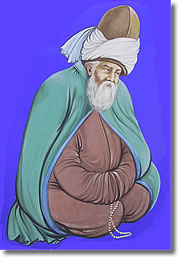 |
| An artist's conception of Mevlana (Rumi) in old age |
Disconsolate, Rumî withdrew from the world to write his poetic masterwork, the Mesnevi (Mathnawi in Persian). He lived and worked in Konya for another quarter century, sometimes whirling in the streets from sheer joy and spiritual delirium.
After his death (known as Şeb-i Aruz, his "wedding night with God"), a Sufi (Islamic mystic) order called the Mevlevi ("Followers of Mevlana," or Whirling Dervishes) was founded by his son, Sultan Veled, based on Rumî's principles and practices.
Learn all about Rumi and see the dervishes whirl in his memory in Konya on a Rumi Tour. Dervishes also whirl every week in Istanbul. More...
| Mevlevi Whirling Dervishes |


 Best Travel Agencies
