


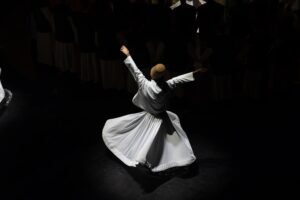
The Mevlevi sema, or dervish mystic religious rite, is an elaboration of the whirling done by Mevlana Jelaleddin Rumi in ecstasy on the streets of Konya, Turkey in the 13th century.
The ceremony has seven parts symbolizing the whirling dervish's love of God, humankind and all creation:
1. Natt-i Şerif
Praise for God the Creator, for the Prophet Muhammed, and for the prophets preceding him (Musa/Moses and Isa/Jesus, etc.)
2. Kudum
The beating of a small kettledrum symbolizes the command of God which created the universe: "Be!"
3. Ney
The soulful, breathy music of the ney, the open-ended reed flute of the Mevlevi, symbolizes the breathing of life into all creatures.
4. Greeting
The dervishes greet each other three times, a symbol of the soul being greeted by its secret soul.
5. Whirling
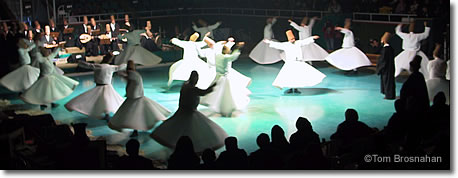
The dervishes drop their black cloaks to reveal white costumes fitted to the torso, but with long, flowing skirts. The dropping of the cloak symbolizes the casting off of falsehood and the revelation of truth. Each dervish places his arms on his chest to symbolize his belief in the Oneness of God, "the One." Bowing, he kisses the hand of the Sheikh Efendi (spiritual leader) and seeks permission to enter the sema.
As he enters, each dervish slowly unfurls his arms, his right handreaching up to heaven to receive its blessings, the left hand down to communicate them to earth. He whirls counter-clockwise (anti-clockwise), right to left, with his heart at the axis of the turn.
The dervishes complete four whirling sessions of approximately 15 minutes each, resting briefly between sessions. The Sheikh Efendi joins in the final session, turning slowly.
6. Prayer
Prayers are recited from the Kur'an in praise of God.
7. Fatiha
Recitation of the Fatiha, or first chapter of the Kur'an, in memory of all prophets, martyrs and believers, followed by a prayer for the welfare of the nation and its leaders.
Non-dervishes, Muslim and non-Muslim, have always been welcome to witness the sema, a spiritual gift to all creation.
Ironically, it's easier to witness the Mevlevi sema in Istanbul than in Konya. More...
—by Tom Brosnahan
| Mevlevi (Whirling) Dervishes
Mevlana Cultural Center in Konya |

 Best Travel Agencies
