


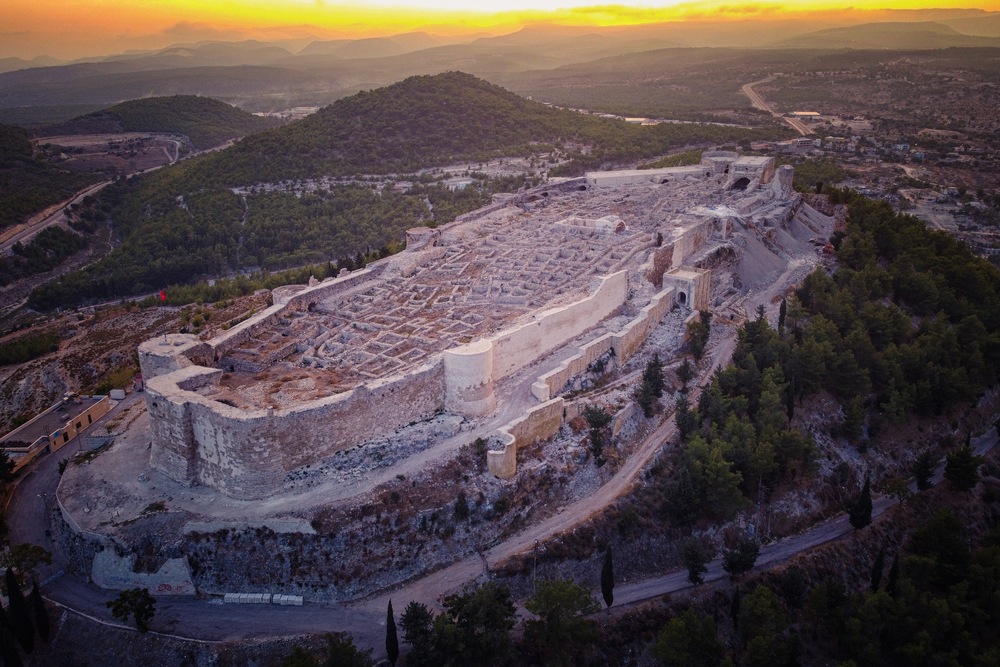
Founded by Seleucus I Nicator (one of Alexander the Great's generals) in the 3rd century BC, Silifke (see-LEEF-keh, pop. 60,000) has a few interesting historic sights, such as:
—The Byzantine fortress commanding the town from a hilltop
—The Tekir Ambarı, an ancient stone cistern blow the fortress
—Ruins of the Roman Temple of Jupiter
—A small Archeological Museum
—The Great Mosque (Ulu Cami) with foundations from Seljuk Turkish times
—The Reşadiye Mosque, built by the Ottomans using columns recycled from the Temple of Jupiter.
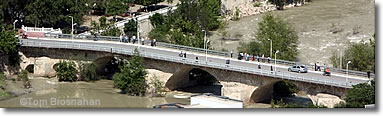
Roman stone bridge, Silifke.
Cave-Church of St Thecla
About 5 km (3 miles) from Silifke's otogar (bus station) off the road to Taşucu is the Cave of St Thecla(Ayatekla). A young virgin from Iconium (Konya), Thecla overheard St Paul preaching in her neighbor's house and converted to Christianity. Persecuted for her beliefs, she triumphed and was revered by the Byzantines, who built a splendid church above the cave where she allegedly sought shelter from her persecutors. The church is now in ruins, but the cave beneath is a place of pilgrimage for Christians.
Where to Stay
Silifke's better hotels and villas are in Taşucu, and nearby Kızkalesi has a better, brighter selection and overall is probably a better place to stay the night.
Silifke Transport
Bus and minibus traffic between Silifke and Adana (via Kızkalesi, Mersin and Tarsus) is fast and furious all day, making it easy to travel the eastern coast by public transport. More...
Fast ferries to Girne (Kyrenia) in northern Cyprusdepart from the Silifke suburb of Taşucu (TAHSH-oo-joo), 11 km (7 miles) west of Silifke's otogar (bus terminal). More...
—by Tom Brosnahan
| Silifke & Taşucu Transport |

 Get a Quote
