


The Roman/Byzantine mosaics in the Hatay (Antakya) Archeology Museum (Antakya Arkeoloji Müzesi) are the main attraction in this city at the far eastern end of Turkey's Mediterranean coast, though the city's long history has left much more behind.
In 2014 the new museum building, with the world's largest display area for mosaics, is set to open.
The mosaics, dating from the 1st to 5th centuries AD, are well displayed. Most labels are in Turkish and English. The museum is open 08:30 am to 12:30 pm and 13:30 to 17:30 (1:30 to 5:30 pm), closed Monday.
The mosaics were recovered from Antioch ad Orontes(Antakya), the garden suburb of Daphne (now called Harbiye), from Roman Mediterranean seaside villas, and from Tarsus by archeological teams from Princeton University in the early decades of the 20th century. The museum opened to the public in 1948.
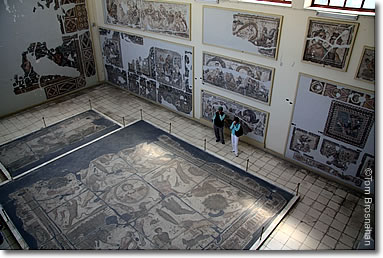
Perhaps the richest collection of Roman mosaics in the world...
The artistry of the mosaics is amazing: look close, and all you see is little bits of colored stone. Look from the optimal distance and you see distinct images with subtle colors.
The Antakya Arkeology Museum is not just its Roman mosaics, however. Several halls are dedicated to other aspects of Roman and Byzantine culture, with exhibits of marble sarcophagi, coins, pots, tools, glassware and statuary.
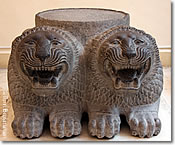 |
| Twin lions, 8th-century BC |
You'll certainly notice the beautifully-carved 8th-century BC twin lions on a column pediment.
Many of these finds were discovered by Chicago Oriental Instituteteams working at Cüdeyde, Dehep, Çatalhöyük and Tainat from 1933 to 1938. Others were contributed by Sir Leonard Woolley, excavating at El Mina in Samandağ and at Tell Atchana (Aççana Höyüğü) between 1936 and 1939.
If you're interested in Roman mosaics, you should also consider a visit toGaziantep to admire the beautiful mosaics rescued from ancient Zeugma, now inundated by an artificial lake. More...
Hatay (Antakya) Arkeoloji Müzesi
Cumhuriyet Meydanı (map)
Gündüz Caddesi No. 1
Hatay (Antakya), Turkey
Tel: +90 (326) 214 6167, -68
Fax: +90 (326) 214 6167
hatayarkeolojimuzesi@yahoo.com
—by Tom Brosnahan

 Get a Quote
