


Antakya’s 2000+-year history is among the most eventful, brilliant and tragic in a region where such histories are commonplace.
Seleucus I Nicator (321-281), successor to the empire of Alexander the Great, laid out a plan for this city about 300 BC. It became the capital of the Seleucid Empire stretching from Macedonia nearly to India.
The empire facilitated trade, and Antioch became an important point on the Silk Road, with caravans of luxury goods bringing fabulous wealth and a scandalously sybaritic lifestyle. Remnants of this can be seen at Daphne (Harbiye). More…
Under the Romans, Antioch-ad-Orontes was the capital of the province of Syria with a population around 500,000. It became one of the empire’s greatest cities—only Rome and Alexandria were greater—with a considerable Jewish community.
Saint Peter came here to preach, and Saints Paul and Barnabas used it as their base for missionary work. Converts from the local Jewish community were many, but it was here that the saints decided to expand their mission to Gentiles as well, calling their followers Christians.
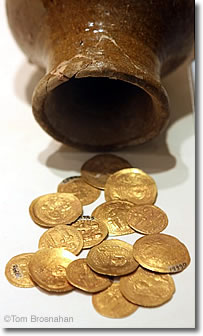 |
| Trove of gold coins. |
Antioch flourished under the Byzantines until in the 500s a violent earthquakeruined it, killing 200,000 people. Later overrun by the Persians, then the Arabs (700s) and the Seljuk Turks (1084), it regained importance under the Crusaders(1098) as the capital of their Principality of Antioch, but conquest by the Mamelukes in 1268 saw its utter destruction.
What the Ottomans claimed in 1516 was only a shadow of its former self, and it later declined to just a village.
After the collapse of the Ottoman Empire following World War I, Ottoman Syria, including Antakya, was placed under French Mandate government. By a plebiscite in 1939 it was returned to Turkey along with the entire Sanjak of Alexandretta, the province now called Hatay.
—by Tom Brosnahan
| Archeology Museum |  |




 Best Travel Agencies
