


You'll stay in a variety of hotel rooms in Turkey. Here are wisdom and travelers' tips from a guy who has stayed in at least a thousand of them.
Electricity
200-240 volt, 50 Hertz, as in Europe. There may be few outlets/points, there may be several. Lightbulbs are energy-efficient and usually low-lumens. Good bedside reading lights are rare.
You may have to stick your room key card or toggle into a slot near the door to activate all the electricity in the room. When you take your key and leave the room, your mobile phone, tablet, laptop, camera, etc. may stop charging. The best hotels have at least one outlet that's always powered, for charging devices without interruption.
Bathroom
Most bathrooms have portable hair dryers, but may not have a stopper for the sink, as Islam requires ablutions to be done in running water. In recent years, the better hotels catering to non-Muslim visitors have been installing metal stopper mechanisms in the drain: push down to seal, push again to release.
As in Europe, most hotel rooms have no washcloths (which North Americans love). Bring one with you if you want one reliably. There may be facial tissues, but bring your own supply in any case.
If there seems to be no hot water, increase the flow. If heating is by a flash heater, a certain pressure is needed to trigger the gas flame. Turn on the hot water in the shower or bathtub. Let the water run. It may have to travel a distance from the heater to reach your tap. If there's still no hot water, try the cold water tap. In about 8% of cases, the plumber has mixed up the taps and the cold is really hot. If the taps in the sink are mixed up, the bath/shower taps may...or may not be...and vice-versa.
If the shower is off the handheld-on-a-hose("telephone") variety, it may be subject to a wide variety of problems: leaky hose or connections, defective wall mount, clogged jets, inoperable valve—the list goes on. On one shower, the direction of flow was controlled by the water pressure: if I turned up the flow too much, the head rose and sprayed the ceiling. If I turned it down too much, it sprayed the wall.
Bathroom floors may be smooth tile, marble or other stone. Such floors are not particularly slippery when both your feet and the floor are dry, but read and believe:
—Dry floor, dry feet = not slippery
—Wet floor, wet feet = a bit slippery
—Wet floor, dry feet = VERY SLIPPERY!
—Dry floor, wet feet = VERY SLIPPERY!
Also, watch your step entering a bathroom with a marble threshold. If the threshold is raised and rectangular (not chamfered), it's easy to stub your toe (which, in bare feet, can be seriously painful.)
Toilet
Most are ecological water-saving types. Push the large part of the flush control for major waste, the small part for liquid. On many toilets, this doesn't work and you get the same flush no matter what.
What's that funny little nozzle at the back of the bowl? What's this about not throwing toilet paper into the bowl? See my Turkish toilets page.
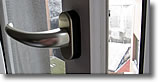 |
| Swing window open |
Windows
Most are energy-efficient double-glazed, which also helps keep out noise. Many open two ways: lift the lever-handle to a horizontal position and swing the window open like a door. Lift the handle all the way to vertical and the top of the window tips back to allow air but not rain (or people) to get in. The bottom remains in the frame. Clever!
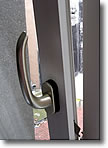 |
| Tilt window open |
Some Ottoman-style hotels have double-hung windows, usually without counterweights, so they're heavy to lift and dangerous if they fall. Lift the sash then look for the funny little metal tab on the window frame, and swing it so that it's underneath the sash you've lifted, blocking its descent. Cumbersome, but it works.
If you drop the heavy window sash on your fingers, you will never forget the experience.
Insect screens, though sensible, are rare in Turkey (as in Europe generally). If your hotel has them, it is run by an enlightened person. If not, you may have a few flies and mosquitoes sharing your room with you (even in Istanbul, even in cooler months).
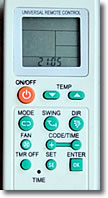 |
| A/C remote control |
Climate Control
Large hotels, especially older ones, will have central heating and air-conditioning systems that are often not cool enough in summer and not warm enough in winter. Newer and smaller hotels have individual wall-mounted remote-control room air conditioning/heating units that work well and are preferable to central systems. Hotels in colder regions have traditional hot-water radiators as well.
Remote controls (kumanda) vary in their level of obscurity from almost-intuitive to utterly inscrutable. You may have to ask the staff for help in learning how to operate them.
Bed
Usually good and firm, with clean sheets and a duvet (quilt) for warmth. Hoteliers love duvets because, unlike blankets, they can be stuck in a cotton cover and don't need to be cleaned often. However, they're way too hot for me in a hotel room, and as few hotels furnish blankets as alternatives, I'm often either too hot or too cold and don't sleep well. I usually shake the duvet out of its sheet-sack and use just the sheet.
If your hotel has blankets as well as the duvet, it is a hotel fully in touch with its guests' needs. If you don't see a blanket, ask for one.
In a few hotels, light switches may be right at pillow level on the headboard, which means when you shift position in your sleep in the middle of the night, the lights come on, startling you awake.
Older beds in cheaper hotels may have sharp corners which can gouge your shins as you pass by.
Minibar/Minifridge
Turkish minibars/minifridges don't usually keep drinks very cold, but drink prices are high. Most hotels even charge a fee for bottled drinking water, which is stupid—making you go out to a shop to buy a daily necessity so you won't have to pay an exorbitant price for it. This is hospitality? What are they thinking?
Our bodies are 60% water. Doctors say we should drink between 1 and 3 liters of liquid each day. The better hotels provide at least some bottled water at no charge. The best give you an adequate daily supply—a 1.5-liter bottle for two people, per day, would barely be enough.
Wifi Internet
Most Turkish hotels, inns and pensions, even the smallest, cheapest ones, provide wireless Internet. It's usually free except in the 5-star vacuum-hose-in-your-wallet luxury hotels.
Most hotels require a password (şifre, SHEE-freh) to connect. Ask for it when you register to save yourself a phone call later to the reception desk.
Quality strength and speed of Wifi connection varies by the hotel, room, time of day, the capacity of Internet connection and number of computers connecting to a given system. Fastest connections are often in the middle of the night.
If you bring a smartphone with Wifi hotspot capability, you can buy a Turkish SIM card for the phone and a data package for access, and get your own Internet connection, which is often faster than a hotel's.
Television
Even many budget hotel and hostel rooms have TV sets in them with most channels in Turkish, a few in Arabic, Chinese, English, French, German, Italian, Korean, Russian, Spanish, etc., depending on the hotel's customary clientele. Foreign-language channels are usually for news. Most of the programming on most of the channels sucks most of the time.
Housekeeping Staff
Mostly hard-working, pleasant, responsible women with families, they merit your appreciation. I never fear they will molest my belongings. I always leave a tip equivalent to a few dollars or euros per day.
Coffee & Tea Equipment
The exception rather than the norm in Turkish hotel rooms, though their presence in hotel rooms is growing, and they are usually provided in suites and rental apartments/flats to let. Usually complimentary (free), appreciated when there, and include instant coffee, black and herbal teas, sugar and "non-dairy creamer." Look in your minibar to see if there's real milk, and if there is, love your hotel.
That Odd Vanity
Since the beginning of modern Turkish tourism in the 1960s, until the end of the century, virtually every Turkish hotel room had a small vanity with mirror, a tiny table, and stool or chair so ladies could do their makeup. Most of these odd constructs are impractical, a waste of space, and an anachronous misinterpretation of foreign cultures, like the "American bars" that were designed into every hotel lobby and featured in all brochures, but never used.
Someone should tell Turkish hotel architects that women put their makeup on in the bathroom. Thus, have good mirrors and low-Kelvin-temperature light over the sink.
—by Tom Brosnahan

 Best Travel Agencies
