


Each compartment in a Turkish State Railways (TCDD) sleeping car (yataklı vagon) converts to sleep two people.
Each compartment has a sink with running hot and cold water for washing face and hands, a tiny towel and bar of soap, mirror, clothes hangers, luggage rack, smallcabinet, window to the outside (with roll-up blind and thick velvet light-blocking curtain), heating, fan or air conditioning, and a waste receptacle.
The 220-volt low-amperage electrical outlet over the sink is designed for electric shavers. It will recharge your mobile phone, camera battery or laptop computer, but it may cut off after awhile. Just unplug your device, wait a minute, and plug it in again, and it will work for awhile.
The TCV2000 sleeping cars have small mini-bar refrigerators for drinks and snacks in each compartment, with a small container of drinking water and a few snacks for you.
The berths have comfortable firm mattresses, sheets, blankets and pillows. A movable ladder gives access to the upper berth.
There are toilets at each end of each sleeping car, usually a flat “elephant’s feet” toilet at one end, and a raised western-style commode at the other end. The TCV2000 cars also have a tiny shower.
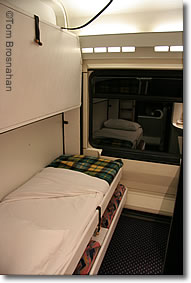 |
| The lower berth (upper berth not made ready). |
Sleeping car fares areinexpensive by European or North American standards.
Unlike couchettes or passenger cars, sleeping compartments are private: one person or a couple rent the entire compartment, assuring privacy.
Each sleeping car has its own porter who makes the beds in the evening, converts them to seats in the morning, brings drinks and snacks to passengers in the compartments, announces meal times, and generally sees to passengers’ comfort and welfare.
Sleeping compartments can be locked from the inside by their occupants, but only the porter can lock a compartment from the corridor.
A sleeping compartment berth isn’t as long or wide as a regular bed, but is fairly comfortable unless you’re over six feet (183 cm) tall or particularly wide. However, I find that the porter’s way of making the bed—with both the top and bottom sheet, and even the blanket, folded in half and tucked in, doesn’t work for me. I always tear the sheets and blanket off and re-make the bed to my liking.
If you are sensitive to light when you sleep, you should bring something with which to cover the compartment’s night light, which comes on automatically and is very bright (Turks don’t like sleeping in pitch dark). A 4-inch-by-4-inch (10 cm by 10 cm) square of cardboard and some sticky tape would be good.
Also, the spring-loaded window shade may refuse to stay all the way down, so jam a slip of paper into the space on the side between the bottom rail and the side track. That holds it.
The top part of the compartment’s window can usually be opened a bit for fresh air if you wish, but only if the window shade is all the way up. Otherwise, fresh air-conditioned air is admitted through the vents at the top of the compartment, and exits through the vent beneath the window.
Please read this safety notice about sleeping car travel.
For any sleeping car trip, I usually pack a 1.5-liter bottle of water and some snacks.
Sleeping cars are usually ready for passenger boarding about 30 minutes before departure, so if you arrive early at the station you can relax in privacy rather than wait in the waiting room.
Here are the trains that haul sleeping cars in Turkey.
—by Tom Brosnahan
| Summary of Turkish Trains |  |

 Best Travel Agencies
